



Isle of Bute by Train and Ferry
The Isle of Bute is a train and ferry journey from the mainland: the train to Wemyss Bay, then a 35min crossing to Rothesay. The terminal is a short walk from the platform.
Windy Hill, 278m, is the highest of Bute's 4 listed hills.
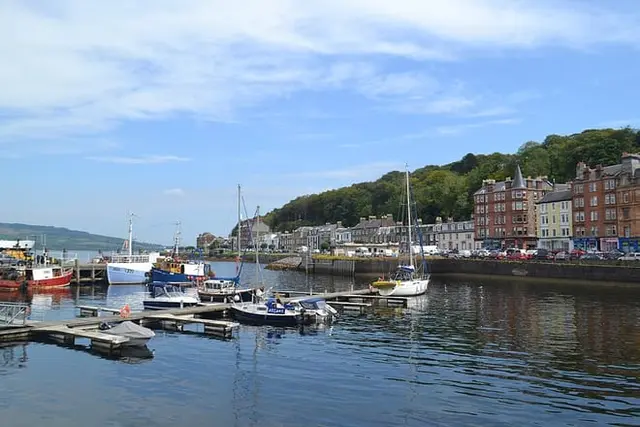
Photo: Daniel from Glasgow, United Kingdom, CC BY 2.0, via Wikimedia Commons
How to get to Bute by train
The train takes you to the ferry port, and the ferry carries foot passengers, so you can walk on with a rucksack and no car.
Train and CalMac ferry
Train to Wemyss Bay, 35min ferry to Rothesay
The ferry terminal is a short walk from the platform. Wemyss Bay station
Walking distances are estimates from the straight-line distance and the type of ground, not a measured route. Check a map before you set off.
Train times to Wemyss Bay from Glasgow, Edinburgh and more
The quickest train from each city to the ferry port. Then add the crossing: 35min from Wemyss Bay.
| From | To Wemyss Bay |
|---|---|
| Glasgow | 51min |
| Stirling | 1hr 42min |
| Edinburgh | 1hr 57min |
| Lancaster | 3hr 18min |
| Newcastle | 3hr 51min |
| Durham | 4hr 10min |
Hills you can walk to from the ferry
2 listed hills lie within 3 miles of the Rothesay terminal as the crow flies, so you can start walking straight off the ferry.
- Common Hill132m · 0.8 mi (about 1 mi on foot)
- Barone Hill162m · 1.6 mi (about 2 to 2.5 mi on foot)
Hills on Bute
Bute has 4 listed hills, including 1 Marilyn. Windy Hill is the highest at 278m.
Marilyns on Bute
- Windy Hill278m
Protected places on Bute
None of Scotland's National Scenic Areas, Wild Land Areas, National Nature Reserves or Special Areas of Conservation lies mostly on Bute.
Can you visit Bute without a car?
Yes. The ferries carry foot passengers, so you can arrive with a rucksack and no car. 2 listed hills start within 3 miles of the terminal. We don't list island buses, so for anywhere further from the ferry, check local transport before you travel.
More Scottish islands by train and ferry
- Isle of SkyeTrain to Mallaig, 30min ferry to Armadale
- Isle of MullTrain to Oban, 50min to 1hr ferry to Craignure
- Isle of ArranTrain to Ardrossan Harbour, 55min ferry to Brodick
- BarraTrain to Oban, 5hr 35min ferry to Castlebay
- South UistTrain to Mallaig, 3hr 30min ferry to Lochboisdale
- The Small IslesTrain to Mallaig, ferry to Eigg, Muck, Rùm and Canna
- Coll and TireeTrain to Oban, ferry to Coll and Tiree
- OrkneyTrain to Aberdeen, 6hr ferry to Kirkwall
- ShetlandTrain to Aberdeen, 12hr 30min ferry to Lerwick
Also by train and ferry: English, Welsh and Manx islands.